
The Complete Guide to Developer Compensation in France 2025: Strategic Insights for Competitive Hiring
The French tech landscape has never been more dynamic, with over 500,000 tech jobs available and a projected market value of €70 billion by 2025. This comprehensive analysis reveals the current state of developer salaries in France...

The French tech landscape has never been more dynamic, with over 500,000 tech jobs available and a projected market value of €70 billion by 2025. As companies compete for top talent in an increasingly tight market, understanding developer compensation strategies has become critical for success. This comprehensive analysis reveals the current state of developer salaries in France, offering data-driven insights that can transform your hiring and retention strategies.
The stakes couldn't be higher. With 90% of French organizations reporting difficulty finding qualified candidates and developer salaries showing significant variations across experience levels, regions, and company sizes, businesses need sophisticated compensation strategies to attract and retain talent without overspending. This guide provides the strategic framework to navigate these challenges effectively.
Understanding the French Developer Salary Landscape
The Experience Premium: How Skills Translate to Compensation
The relationship between experience and compensation in France follows a distinctive pattern that savvy employers can leverage for strategic advantage. Our analysis reveals that developer salaries increase dramatically in the early career stages, with the most significant jumps occurring between junior and intermediate levels.
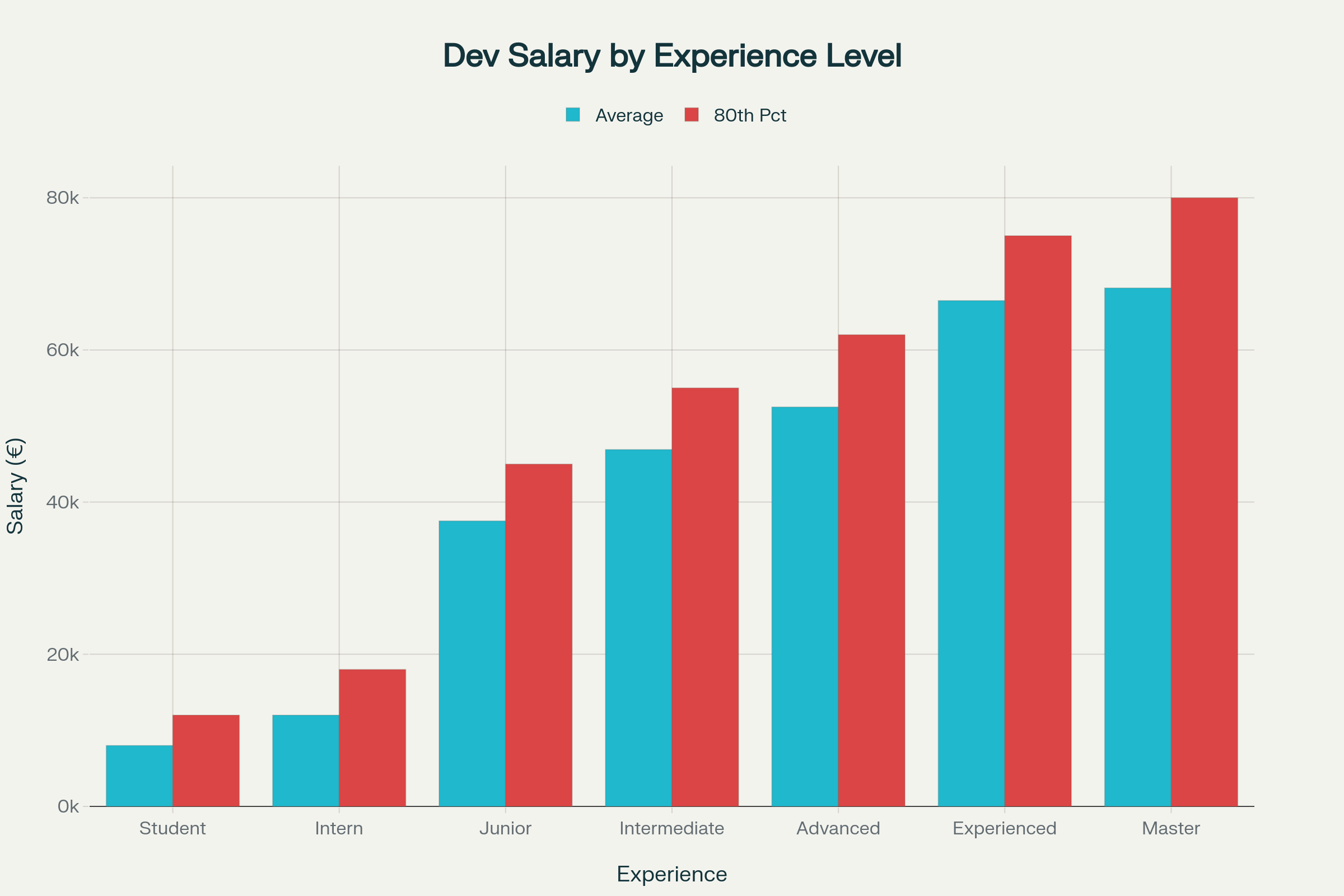
Junior developers in France earn an average of €37,525 annually, representing a substantial 215% increase from intern-level positions at €12,000. However, the real acceleration occurs at the intermediate level, where salaries jump to €46,916 - a 25% increase that reflects the market's recognition of proven competency and reduced training overhead.
The 80th percentile salary serves as a crucial benchmark for competitive positioning. At this threshold, 80% of developers earn less while 20% earn more, making it an ideal target for companies seeking to attract top talent without extreme overspending. For intermediate developers, this translates to approximately €55,000, providing a clear ceiling for competitive offers.
Advanced and experienced developers command significantly higher compensation, with experienced professionals averaging €66,481 and master-level developers reaching €68,153. Notably, the progression curve flattens at senior levels, with only a 2.5% difference between experienced and master categories - a pattern that has important implications for retention strategies.
Regional Dynamics: The Geography of Tech Compensation
France's diverse economic landscape creates substantial regional variations in developer compensation, offering strategic opportunities for cost-conscious employers and location-flexible professionals.
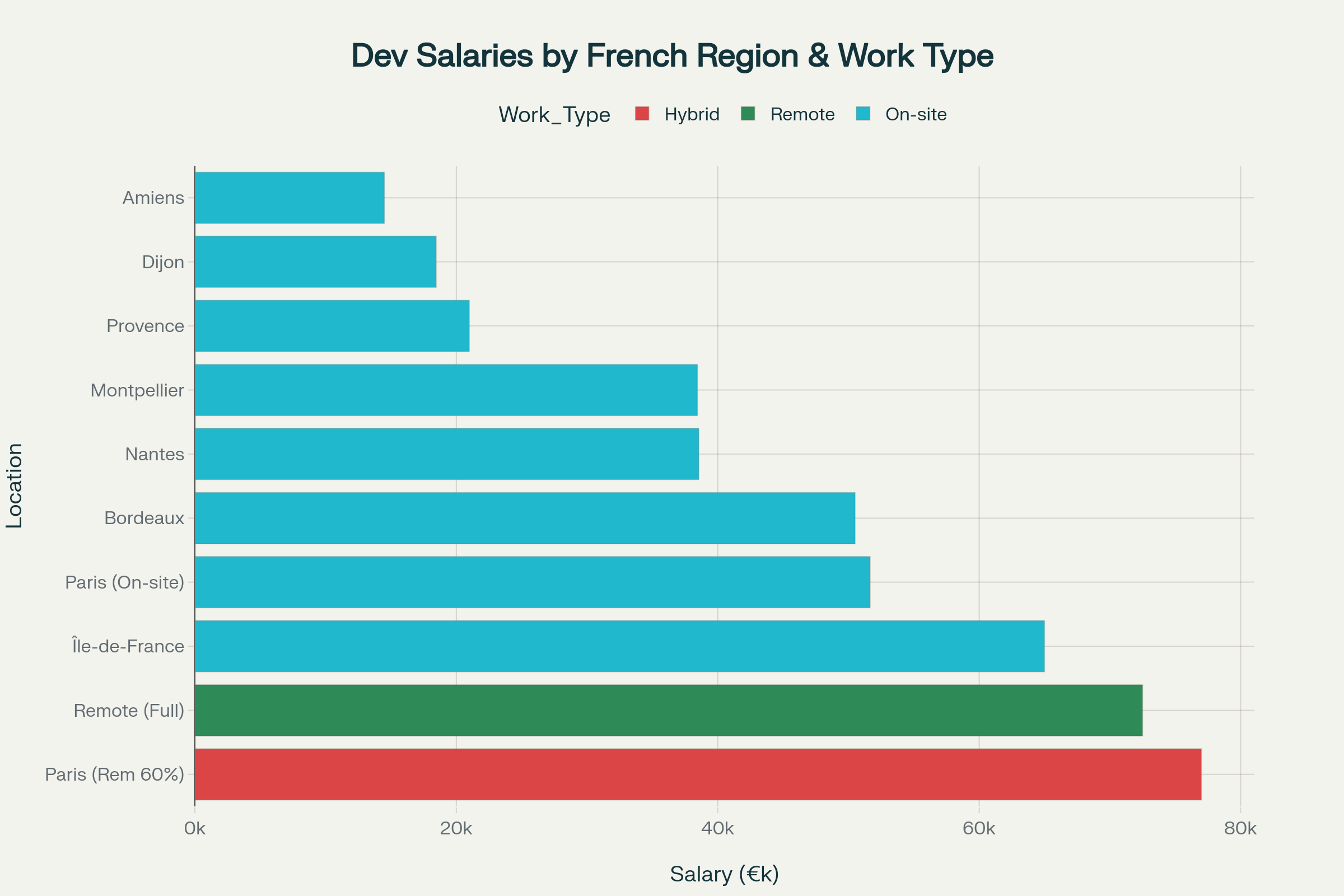
Paris remains the premium market, but the data reveals nuanced patterns that challenge conventional wisdom. Traditional on-site positions in Paris average €51,665, while hybrid arrangements with 60% remote work command €77,000 - a remarkable 49% premium that reflects the market's evolution toward flexible work models.
Fully remote positions average €72,500 across France, representing approximately 17% higher compensation than traditional regional markets like Île-de-France at €65,000. This premium reflects the competitive advantage remote work provides in accessing global talent markets while maintaining French employment benefits.
Secondary markets offer compelling value propositions for strategic hiring. Cities like Bordeaux (€50,512), Nantes (€38,550), and Montpellier (€38,450) provide access to skilled developers at 20-40% savings compared to Paris on-site positions. This geographic arbitrage represents a significant opportunity for companies willing to embrace distributed teams or establish satellite offices.
The Company Size Effect: Scaling Compensation Strategies
The relationship between organizational size and developer compensation in France reveals complex dynamics that extend beyond simple linear progression.
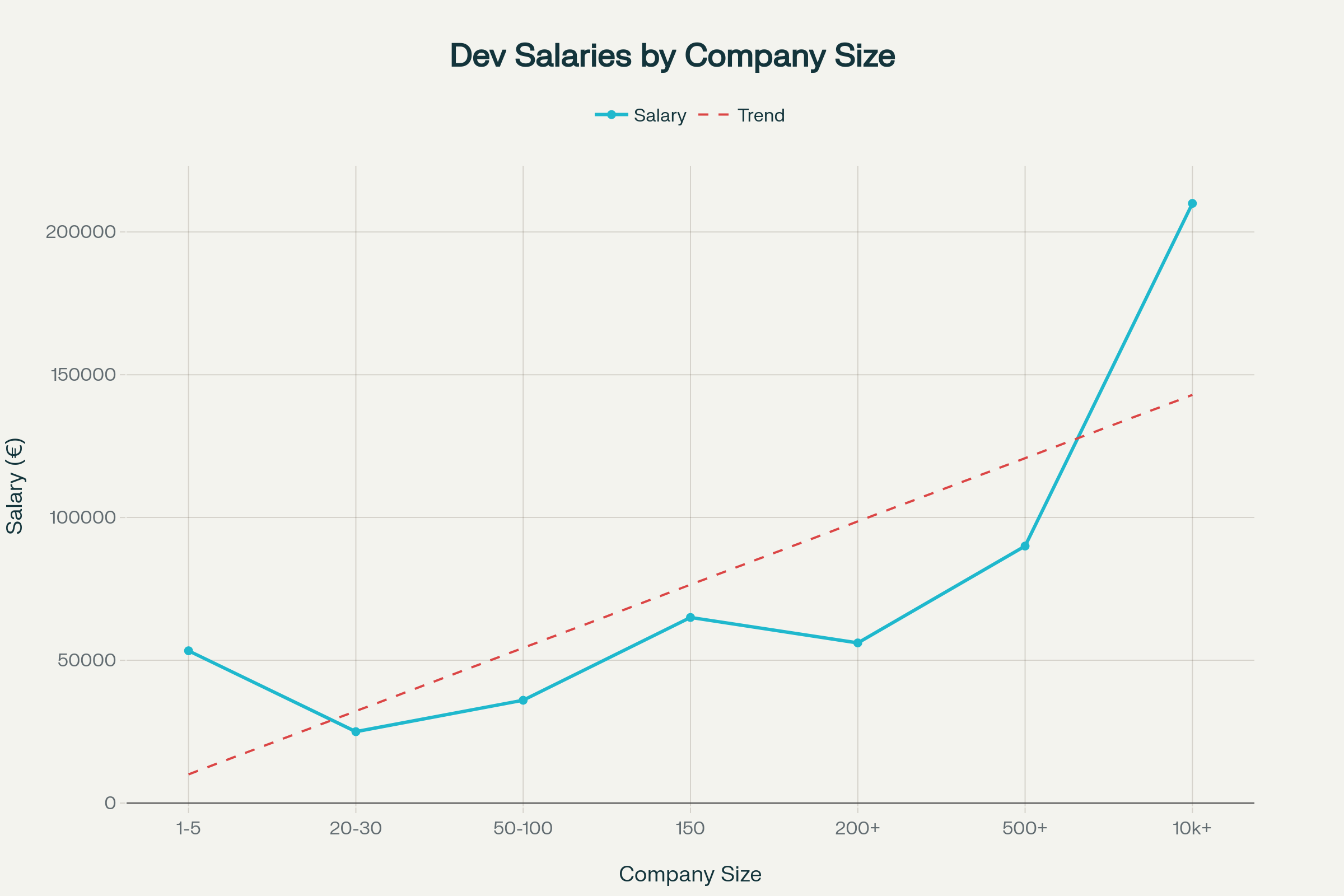
Startups and small companies (1-5 employees) surprisingly offer competitive salaries averaging €53,333, often leveraging equity compensation and growth opportunities to attract talent. However, the market shows volatility in the small company segment, with some organizations in the 20-30 employee range offering significantly lower compensation at €25,000, likely reflecting funding constraints or market positioning challenges.
Mid-market companies (50-200 employees) typically offer salaries ranging from €36,000 to €65,000, representing the most stable segment of the market. These organizations often provide the optimal balance of competitive compensation and career development opportunities without the bureaucratic complexity of larger enterprises.
Large enterprises (500+ employees) demonstrate the market's most significant compensation acceleration, jumping from €56,083 at the 200+ level to €90,000 for companies with 500+ employees. The extreme outlier at €210,000 for organizations with 10,000+ employees likely reflects specialized roles or executive compensation rather than standard developer positions.
The French Tech Market Context: Opportunities and Challenges
Market Growth and Opportunity Landscape
The French tech ecosystem is experiencing unprecedented growth, withthe sector projected to reach €150 billion by 2025, growing at 4.5% annually. This expansion is driven by several key factors that directly impact compensation strategies:
AI and deeptech leadership: France now hosts over 2,500 deeptech startups, ranking 4th globally behind the US, China, and the UK. The government's €109 billion AI investment plan and landmark events like the AI Action Summit are creating premium demand for specialized technical talent.
Venture capital resilience: Despite market corrections, French startups raised €7.1 billion in 2024 (+3% year-over-year), with AI companies accounting for 27% of all capital raised. This continued investment flow supports competitive compensation packages, particularly for companies in high-demand sectors.
Talent shortage severity: The market faces critical skill shortages, with over 15,000 unfilled cybersecurity positions and rapid 21% growth in AI, machine learning, and cybersecurity roles. This supply-demand imbalance creates upward pressure on salaries across technical specializations.
International Competitiveness
France's developer compensation must be evaluated within the broader European context to understand competitive positioning:
European benchmarking shows French developers earning an average of €43,849 annually, ranking 14th globally. This positions France competitively within Europe while offering cost advantages compared to premium markets like Switzerland or the Netherlands.
Remote work arbitrage enables French companies to access global talent pools while offering competitive packages. With 25-50% of software engineering positions offering remote options, organizations can optimize costs while maintaining access to top talent.
Strategic Compensation Management: Best Practices and Tools
The Evolution of Compensation Benchmarking
Modern compensation management requires sophisticated tools and methodologies that extend far beyond traditional salary surveys. The most effective organizations leverage real-time benchmarking platforms that integrate with HR information systems to provide current market data.
Key features of effective benchmarking tools include:
- Real-time data updates from actual employment records
- Regional and industry-specific filtering capabilities
- Integration with existing HR technology stacks
- Compliance support for European pay transparency directives
- Predictive analytics for compensation planning
Retention Strategies Beyond Base Salary
The most successful tech companies in France are implementing holistic retention strategies that extend beyond traditional compensation:
Equity and performance bonuses have become standard tools for tech talent retention. Our analysis reveals that bonus structures vary significantly by experience level, with mid-career professionals (3-10 years) receiving the most consistent bonus payments ranging from €2,900 to €6,200.
Professional development investment shows remarkable ROI, with companies offering comprehensive learning programs reporting 34% higher retention rates. French developers particularly value opportunities for certification, conference attendance, and skill development in emerging technologies like AI and cloud computing.
Work-life balance and flexibility have evolved from perks to essential requirements. Companies offering hybrid work arrangements can command premium positioning in the talent market while potentially reducing real estate costs.
Practical Implementation Framework
Building Competitive Salary Bands
Successful compensation strategies require structured approaches to salary band development:
Tier 1: Entry-Level Strategy (0-2 years)
- Target range: €35,000-€45,000 for competitive positioning
- Focus on comprehensive onboarding and mentorship programs
- Leverage apprenticeship and internship programs for pipeline development
- Consider sign-on bonuses for candidates with relevant certifications
Tier 2: Mid-Career Optimization(3-7 years)
- Strategic range: €46,000-€65,000 with performance-based progression
- Implement clear promotion pathways with defined skill requirements
- Offer technical leadership opportunities and cross-functional exposure
- Provide regular market adjustment reviews to maintain competitiveness
Tier 3: Senior Talent Retention(8+ years)
- Premium range: €65,000-€90,000+ with specialized role differentiation
- Create dual career paths (technical leadership vs. people management)
- Implement retention bonuses and long-term incentive plans
- Offer consulting opportunities and conference speaking engagements
Regional Strategy Development
Paris-centric organizations should consider hybrid models that balance cost efficiency with talent access. Offering 60% remote arrangements can justify premium compensation while reducing office space requirements.
Distributed team strategies enable access to talent in secondary markets like Lyon, Toulouse, and Lille, where skilled developers may be available at 15-25% discounts compared to Paris rates while maintaining high quality standards.
International remote policies can provide access to European talent markets while maintaining French employment law compliance, particularly valuable for specialized roles in AI, cybersecurity, and blockchain development.
Technology Specialization Premiums
High-Demand Technical Skills
The French market shows clear premiums for specific technical competencies:
AI and Machine Learning specialists command significant premiums, with companies like Mistral AI raising €600 million and H Company securing €200 million in 2024. These funding levels support exceptional compensation packages for qualified professionals.
Cybersecurity expertise addresses critical market needs, with over 15,000 unfilled positions creating substantial upward salary pressure. Organizations should expect to pay 20-30% premiums for qualified cybersecurity professionals.
Cloud and DevOps capabilities remain in high demand, with 70% of French organizations reporting difficulty finding skilled cloud professionals. AWS, Azure, and Google Cloud certifications can justify significant salary premiums.
Programming Language Premiums
Market data reveals specific language expertise commands varying compensation levels:
- Golang developers earn the highest premiums at €50,622 annually
- Ruby specialists command €48,581, reflecting demand in startup environments
- Python expertise averages €46,964, driven by AI/ML applications
- JavaScript proficiency offers €45,644, supporting web development demand
Future Outlook and Strategic Recommendations
Market Evolution Trends
The French developer compensation landscape is evolving rapidly, driven by several key factors:
Remote work normalization will likely stabilize hybrid and fully remote salaries at 15-25% above traditional on-site rates. Organizations should plan compensation budgets accordingly while considering reduced facility costs.
AI sector growth will continue driving premium compensation for relevant skills, with generative AI capabilities commanding particular attention given the 6.8x increase in related job postings.
European talent mobility may increase as post-Brexit dynamics settle, potentially affecting comparative compensation requirements for international talent acquisition.
Strategic Implementation Recommendations
Immediate Actions (0-3 months):
- Conduct comprehensive compensation audit using real-time benchmarking tools
- Standardize salary bands across experience levels and geographic locations
- Implement clear bonus structures aligned with business objectives
- Develop remote work compensation policies
Medium-term Initiatives (3-12 months):
- Create career progression frameworks with defined skill requirements
- Establish retention bonus programs for critical technical roles
- Develop partnerships with educational institutions for talent pipeline
- Implement predictive analytics for turnover risk identification
Long-term Strategic Planning (12+ months):
- Build comprehensive employer branding focused on technical excellence
- Develop internal mobility programs to maximize talent utilization
- Create innovation time policies to attract entrepreneurial developers
- Establish mentorship programs connecting junior and senior professionals
Conclusion: Transforming Data Into Strategic Advantage
The French developer compensation landscape presents both significant challenges and tremendous opportunities for organizations willing to adopt data-driven approaches. Success requires moving beyond traditional salary surveys toward sophisticated benchmarking that considers regional variations, experience premiums, and emerging skill demands.
The most successful companies will be those that leverage comprehensive data analysis to build competitive yet sustainable compensation strategies. By understanding the nuances of French market dynamics - from the 49% premium for Paris hybrid positions to the strategic value of secondary market talent - organizations can optimize their talent acquisition and retention investments.
The insights presented in this guide represent the type of strategic analysis that enables market leadership. Companies that fail to adapt to these evolving compensation dynamics risk losing top talent to more agile competitors who understand the true value of data-driven decision making.
This comprehensive salary analysis was created using Glow Reports, an AI-powered platform that transforms complex data into professional, actionable reports. Whether you're analyzing compensation data, market trends, or business performance metrics, Glow Reports enables organizations to generate publication-ready insights from their data in minutes rather than weeks. Create your free account today and experience how AI-driven reporting can transform your data analysis workflow.