
From Quick Queries to Comprehensive Insights: Why Traditional LLMs Fall Short for Enterprise Data Analysis
Uploading your CSV to ChatGPT seems revolutionary until you hit reality: your data becomes training material, millions of rows get truncated, and automation becomes impossible. Discover why LLMs fail at enterprise data work, and how Glow Reports delivers unlimited processing and automated insights.

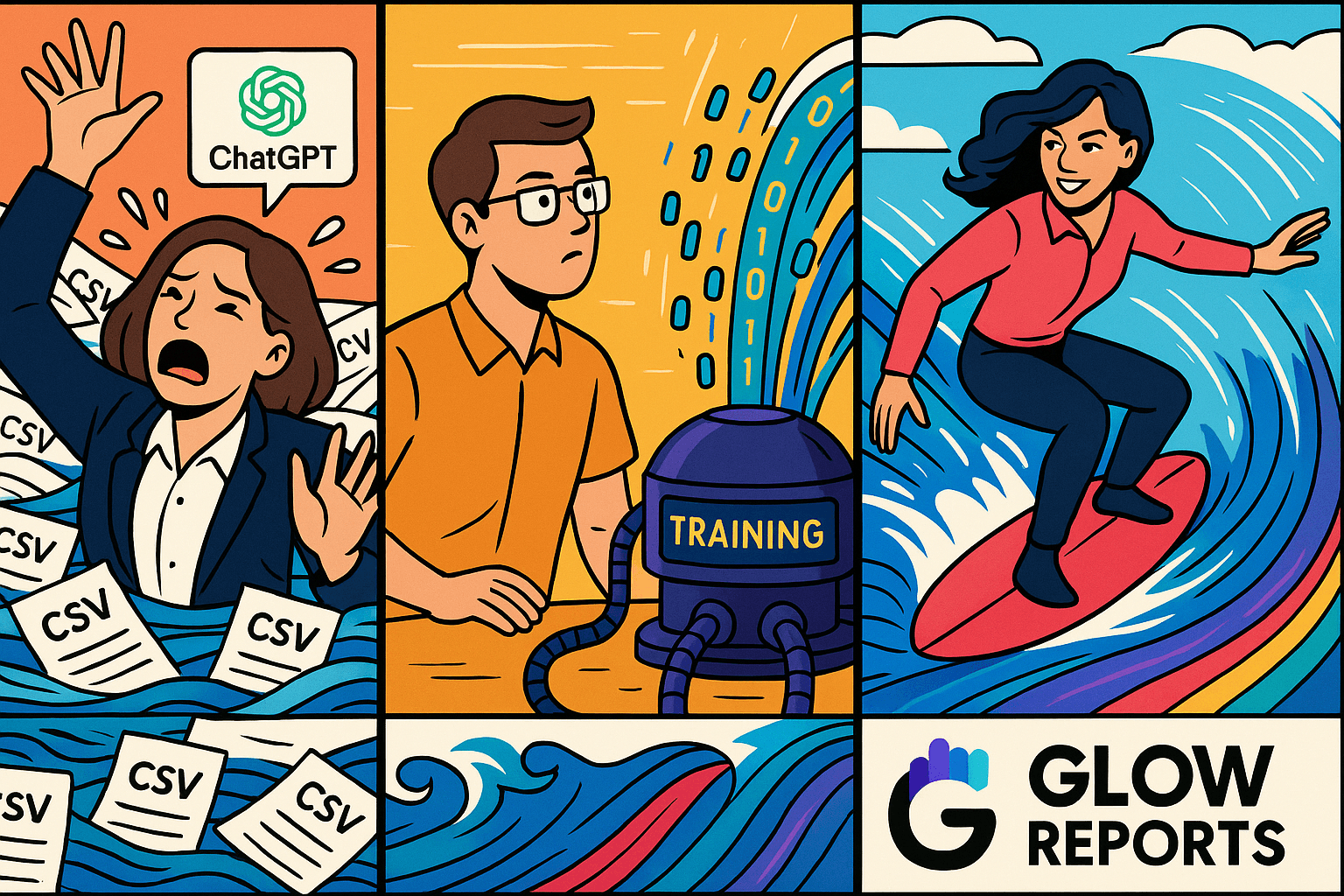
The rapid adoption of Large Language Models (LLMs) like OpenAI's GPT and Anthropic's Claude has revolutionized how businesses approach data analysis. Organizations worldwide are increasingly turning to these conversational AI tools, hoping to unlock insights from their vast data repositories through simple natural language queries. However, beneath the surface of this apparent simplicity lies a fundamental disconnect between the promise of AI-powered data analysis and the reality of enterprise data needs.
While uploading a CSV file to ChatGPT or Claude and asking for insights might seem like the future of business intelligence, this approach reveals critical limitations that can severely constrain an organization's ability to extract maximum value from their data assets. The convenience of conversational interfaces masks deeper challenges around data privacy, scalability, and automation that become apparent when organizations attempt to scale beyond simple exploratory analysis.
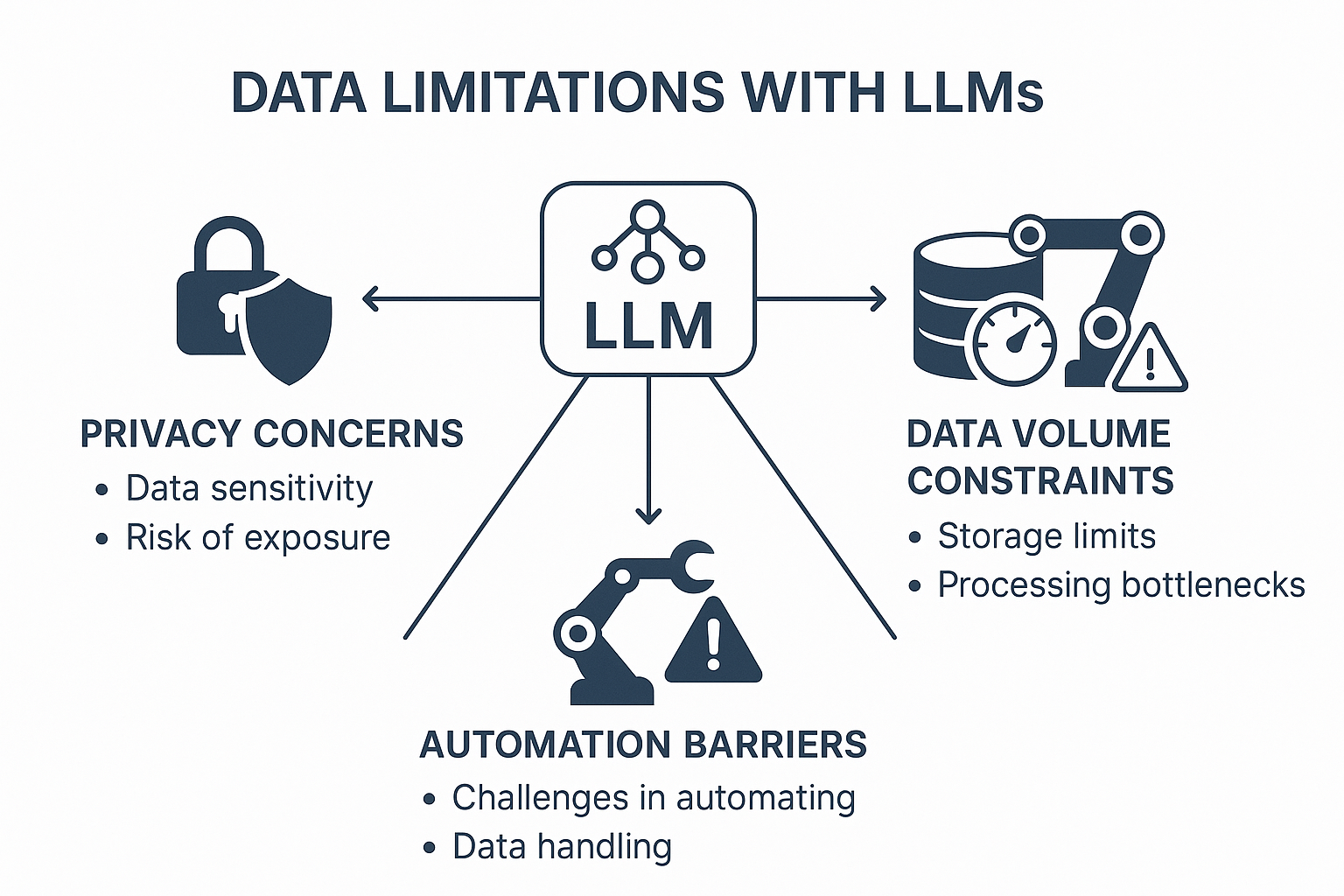
The Three Pillars of LLM Data Analysis Limitations
Privacy and Data Governance Concerns
The most immediate concern when uploading business data to third-party LLM providers centers on data privacy and intellectual property protection. Despite assurances from major providers, the reality of data handling policies reveals significant risks for organizations dealing with sensitive information.
Key privacy challenges include:
- Training Data Usage: OpenAI's policy states that user data is not automatically used for training, but this protection comes with important caveats
- Irreversible Exposure: Even with opt-out selections, data already processed cannot be retroactively excluded from potential training datasets
- Policy Evolution: Anthropic's Claude has shifted toward using user conversations for model improvement, requiring explicit opt-out actions
- Data Retention: Business-critical information becomes subject to providers' retention policies, typically ranging from 30 days to five years
For organizations in regulated industries such as:
- Healthcare (HIPAA compliance)
- Finance (SOX, PCI-DSS requirements)
- Government contracting (FedRAMP standards)
These retention periods may violate compliance requirements or create audit trail complications that expose organizations to regulatory penalties.
Data Volume and Context Window Constraints
The second major limitation involves the fundamental architectural constraints of LLM systems. Context windows, which define the maximum amount of data an LLM can process simultaneously, create hard limits on the scale of analysis possible through conversational interfaces.

LLM Context Window Limitations Comparison
Context window limitations across major providers:
- GPT-3.5: 16,385 tokens (~1,000 data rows)
- GPT-4: 128,000 tokens (~8,000 data rows)
- Claude 3.5: 200,000 tokens (~12,000 data rows)
- Gemini 1.5 Pro: 2,000,000 tokens (~120,000 data rows)
- Grok-2: 131,072 tokens (~7,500 data rows)
Critical constraints include:
- Inefficient Tokenization: Structured data formats consume tokens inefficiently, with spreadsheets requiring significantly more tokens than plain text
- Resource Allocation: Large datasets consume most available context window, leaving minimal space for detailed analysis
- Scale Mismatch: For organizations dealing with millions or billions of records, these limitations render comprehensive analysis impossible
Automation and Scalability Barriers
The third critical limitation involves the conversational nature of LLM interfaces, which inherently restricts automation capabilities and scalable data processing workflows.
Automation challenges:
- Session Limitations: Conversational interfaces operate within discrete sessions, making persistent analytical workflows difficult
- Manual Intervention: Each analysis requires manual data upload, context establishment, and query formulation
- Integration Constraints: Lack of programmatic APIs prevents building automated intelligence systems
- Quality Control Gaps: Limited systematic validation mechanisms compared to traditional data pipelines
Enterprise requirements that conversational LLMs cannot address:
- Regular automated reporting
- Continuous data monitoring
- Systematic multi-dataset processing
- Audit trail maintenance
- Error handling and retry logic
The Medallion Architecture: A Foundation for Scalable Data Intelligence
Recognizing these fundamental limitations, forward-thinking organizations are adopting comprehensive data pipeline architectures that can handle enterprise-scale requirements while integrating AI capabilities where they provide maximum value. The medallion architecture provides a proven framework for transforming raw data into business-ready insights.
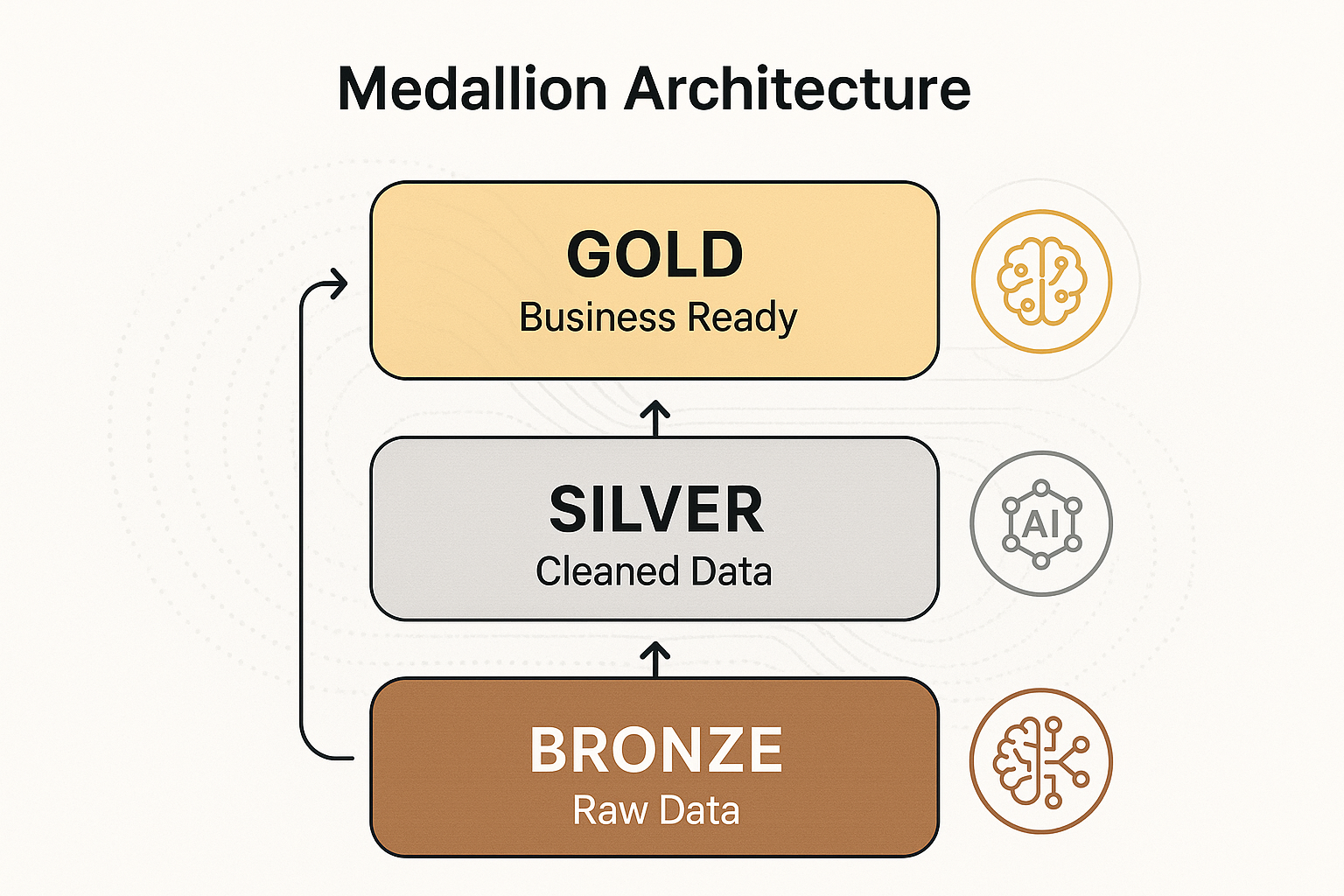
Medallion Architecture: Bronze to Silver to Gold Data Flow
The medallion architecture organizes data processing into three progressive layers:
The Bronze layer serves as the landing zone for raw, unprocessed data from various sources, maintaining data in its original format while adding basic metadata and lineage tracking. This layer prioritizes data capture and preservation over immediate usability.
The Silver layer represents the transformation and cleansing phase, where raw data undergoes standardization, deduplication, and quality enhancement. This layer applies business rules, resolves data inconsistencies, and creates standardized schemas that support downstream analytical requirements. The silver layer serves as the foundation for reliable, consistent data that analysts and business users can trust.
The Gold layer delivers business-ready datasets optimized for specific use cases, whether supporting executive dashboards, regulatory reporting, or machine learning applications. This layer focuses on aggregation, denormalization, and performance optimization to ensure rapid query response times and user-friendly data structures.
Integrating AI Throughout the Pipeline
While conversational LLMs struggle with enterprise data scale, AI technologies can significantly enhance each layer of the medallion architecture when properly integrated into purpose-built data systems. At the Bronze layer, AI-powered data validation and anomaly detection can automatically identify quality issues, schema changes, or unexpected data patterns as information flows from source systems.
The Silver layer benefits from AI-enhanced data cleaning and transformation processes. Machine learning algorithms can automate complex data matching, entity resolution, and standardization tasks that would otherwise require extensive manual configuration. Natural language processing can extract structured information from unstructured data sources, while computer vision can process document and image data streams.
At the Gold layer, AI-driven insights and automated analysis can continuously monitor business metrics, identify trends, and generate predictive models without requiring manual intervention. Unlike conversational LLM interfaces, these integrated AI systems can process unlimited data volumes, maintain historical context across analysis cycles, and generate automated reports and alerts based on predefined business rules.
Open Source Solutions: Building Without Vendor Lock-in
The foundation of robust data pipelines increasingly relies on proven open-source technologies that provide enterprise-grade capabilities without vendor lock-in or licensing constraints.
Workflow Orchestration
Apache Airflow stands as the de facto standard for ETL scheduling and workflow management:
- Capabilities: Python-based DAG definitions, built-in scheduling, retry logic, monitoring
- Community: 36,800+ GitHub stars, active development
- Integration: Supports virtually any data system
- Use Cases: Complex pipeline orchestration, dependency management, failure handling
Real-Time Data Streaming
Apache Kafka excels in event processing and continuous data ingestion:
- Performance: Handles millions of messages per second
- Architecture: Fault-tolerant, distributed streaming platform
- Applications: Real-time analytics, event sourcing, microservices communication
- Scalability: Horizontal scaling across clusters
Big Data Processing
Apache Spark provides distributed processing for petabyte-scale datasets:
- Performance: In-memory computing significantly outperforms MapReduce
- Versatility: Unified API for batch processing, streaming, and machine learning
- Languages: Support for Python, Scala, Java, R, SQL
- Deployment: Cloud-native with auto-scaling capabilities
Data Connectivity and Ingestion
Airbyte offers comprehensive data integration capabilities:
- Connectors: 300+ pre-built integrations
- Approach: API-based and database replication
- Transparency: Open-source architecture allows customization
- Maintenance: Community-driven connector development
SQL-Based Transformation
dbt (data build tool) revolutionizes analytical data modeling:
- Approach: Software engineering best practices for SQL
- Features: Version control, testing, documentation
- Community: 9,800+ GitHub stars
- Integration: Works with major data warehouses
End-to-End ELT Platform
Meltano provides comprehensive pipeline lifecycle management:
- Scope: Extract, Load, Transform orchestration
- Integration: Strong compatibility with other open-source tools
- Management: End-to-end pipeline oversight
- Flexibility: Customizable without extensive development
Performance at Scale: Handling Millions of Records
Real-world performance benchmarks demonstrate the critical importance of choosing appropriate tools for large-scale data processing. Independent testing of ETL tools processing 1 billion rows revealed performance variations exceeding 145x between different solutions. The fastest open-source solution completed processing in 96 seconds, while slower alternatives required nearly 4 hours for the same dataset.
These performance differences become crucial when organizations process millions of rows daily, as required by modern enterprise operations. Effective scalability strategies include data partitioning to break large datasets into manageable chunks, incremental loading to process only changed data, and parallel processing to leverage multiple compute resources simultaneously.
Cloud-native architectures provide additional scalability advantages, enabling organizations to dynamically scale compute resources based on workload demands. This approach prevents the over-provisioning required by traditional on-premises infrastructure while providing cost optimization through pay-per-use models.
Modern data formats such as Apache Parquet and Delta Lake offer significant performance improvements for analytical workloads, providing columnar storage optimization and built-in compression that can reduce storage costs while improving query performance.
AI-Enhanced Business Intelligence: Beyond Conversational Interfaces
While conversational LLM interfaces provide limited enterprise capabilities, AI-enhanced business intelligence platforms offer sophisticated analytical capabilities that scale with organizational needs.
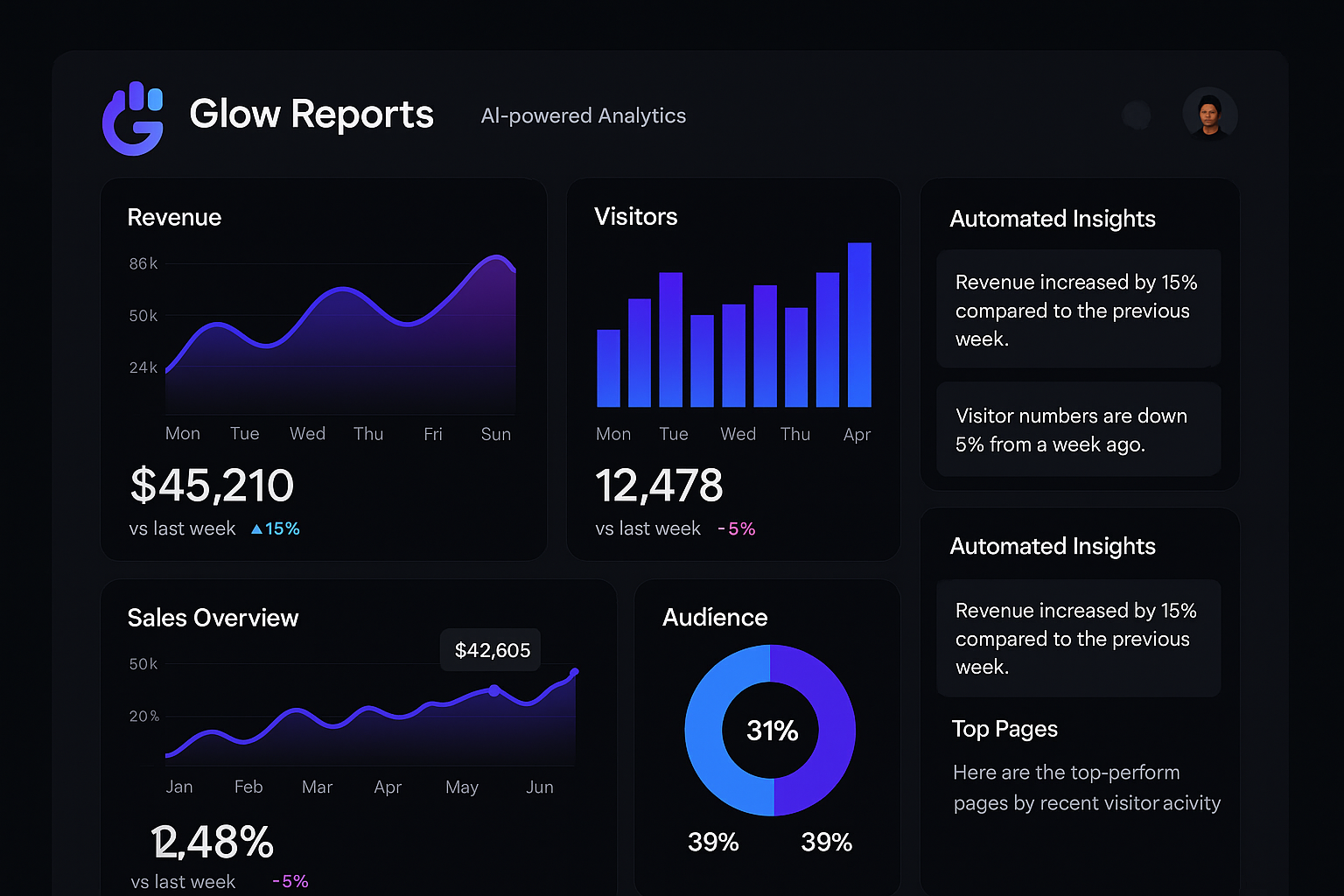
Real-time processing capabilities enable organizations to respond to changing conditions immediately rather than relying on periodic reports. AI-powered dashboards can automatically detect unusual patterns, alert stakeholders to critical changes, and recommend specific actions based on historical data and predictive models.
Natural Language Query interfaces built on top of robust data platforms provide the conversational convenience of LLMs while maintaining access to complete organizational datasets. Unlike standalone LLM tools, these integrated systems respect existing data governance policies, maintain audit trails, and provide role-based access control essential for enterprise environments.
Automated report generation capabilities can produce comprehensive analytical outputs on scheduled intervals, eliminating the manual effort required by conversational LLM approaches while ensuring consistency and completeness. These systems can generate executive summaries, detailed analytical reports, and custom visualizations tailored to specific stakeholder requirements.
The Glow Reports Advantage: Comprehensive Data Intelligence
At Glow Reports, we've engineered our platform to bridge the gap between conversational convenience and enterprise-grade data processing capabilities. Our AI-enhanced ETL pipelines combine proven open-source technologies with proprietary intelligence algorithms.
Enterprise-Grade Capabilities
Unlimited Data Processing:
- Horizontal Scaling: Process millions or billions of records efficiently
- Intelligent Partitioning: Optimize resource utilization automatically
- Performance Consistency: Maintain response times regardless of data volume
- Cost Efficiency: Dynamic resource allocation based on actual needs
Security and Privacy Protection:
- Isolated Processing: All data remains within secure, customer-controlled environments
- Enterprise Data Governance: End-to-End Ownership and Oversight
- Compliance Ready: Support for HIPAA, SOX, GDPR, and other regulatory requirements
- Audit Capabilities: Complete processing and access logging
Automation and Integration:
- Set-and-Forget Operations: Continuous processing without manual intervention
- API Integration: Programmatic access for custom applications
- Workflow Orchestration: Complex multi-step analytical processes
- Error Handling: Automatic retry and failure recovery mechanisms
Multi-Functional Applications
Sales Intelligence:
- Pipeline Analysis: Automated sales funnel performance tracking
- Lead Scoring: AI-powered prospect prioritization
- Revenue Forecasting: Predictive modeling for sales planning
- Territory Optimization: Geographic and demographic analysis
Marketing Analytics:
- Campaign Performance: Multi-channel attribution and ROI analysis
- Customer Segmentation: Behavioral and demographic clustering
- Content Optimization: Performance-based content recommendations
- Channel Attribution: Cross-platform customer journey mapping
Executive Reporting:
- C-Level Dashboards: Strategic performance monitoring
- Board Presentations: Automated executive summary generation
- Investor Relations: Financial and operational metrics compilation
- Strategic Planning: Long-term trend analysis and projection
Project Management Intelligence:
- Progress Tracking: Automated milestone and deliverable monitoring
- Resource Utilization: Team and budget optimization analysis
- Predictive Completion: AI-powered project timeline forecasting
- Risk Assessment: Early identification of potential project issues
Research and Scientific Applications:
- Statistical Analysis: Rigorous analytical methods for peer review
- Data Lineage: Complete reproducibility for academic compliance
- Collaborative Research: Multi-researcher access with version control
- Publication Support: Automated chart and table generation
Conclusion: Moving Beyond LLM Limitations
The promise of AI-powered data analysis extends far beyond the conversational convenience of uploading datasets to ChatGPT or Claude. While these tools serve valuable purposes for exploratory analysis and quick insights, organizations serious about extracting maximum value from their data assets require comprehensive, scalable, and secure analytical infrastructures that address the fundamental limitations of conversational LLM interfaces.
The medallion architecture, powered by proven open-source technologies and enhanced with purpose-built AI capabilities, provides the foundation for enterprise-grade data intelligence. By implementing proper ETL pipelines, automated processing workflows, and AI-enhanced analytical capabilities, organizations can achieve the analytical sophistication that conversational LLMs promise while maintaining the privacy, scalability, and automation requirements that modern businesses demand.
The future of business intelligence lies not in replacing human analysts with conversational AI, but in augmenting human intelligence with comprehensive data processing systems that handle the heavy lifting of data preparation, transformation, and initial analysis. This approach preserves the strategic thinking and contextual understanding that humans provide while eliminating the manual effort and scalability constraints that limit traditional analytical approaches.
Whether your organization needs sales analytics, marketing intelligence, executive reporting, project management insights, or scientific research support, the key to success lies in choosing platforms that provide both the convenience of AI-enhanced analysis and the robustness of enterprise-grade data processing. At Glow Reports, we've solved these challenges so you don't have to, providing the infrastructure and intelligence you need to transform your data into competitive advantage.
Why Choose Glow Reports Over Alternatives?
Vs. Conversational LLMs (ChatGPT, Claude):
- ✅ Unlimited data processing (not limited by context windows)
- ✅ Enterprise security (your data stays in controlled environments)
- ✅ Automated workflows (no manual upload and prompting required)
- ✅ Persistent insights (results available across sessions and users)
Vs. Traditional BI Tools (Tableau, Power BI):
- ✅ AI-enhanced analysis (automated insights beyond basic visualization)
- ✅ Complete data pipeline (ETL processing included, not just visualization)
- ✅ Predictive capabilities (forecasting and trend analysis built-in)
- ✅ Faster implementation (days instead of months to see results)
Vs. Custom Development:
- ✅ Immediate deployment (no months of development time)
- ✅ Proven reliability (battle-tested infrastructure and algorithms)
- ✅ Ongoing innovation (continuous platform improvements included)
- ✅ Lower total cost (no development team or maintenance overhead)
Ready to Maximize Your Data Value?